

Family-Friendly Bogotá: A Journey Through Culture, History, Architecture, Fruits, and Graffiti
Bogotá has a unique charm that I always try to leverage when designing family experiences: within just a few streets, you can travel across several centuries.
A colonial facade might stand right across from a contemporary mural. A plaza can tell stories of independence, politics, and religion. And just minutes later, a fruit that many children have never tasted before can become the highlight of the day.
That is why, when discovering the capital with children, I don't recommend chaining together museum after museum.
I prefer turning the historic center into an adventure.
The goal is to walk, observe, taste, draw, and ask questions. That way, history stops feeling like a classroom lesson and Bogotá becomes a giant stage waiting to be discovered.
This experience works exceptionally well for families with children, but also for couples, solo travelers, groups of friends, and older adults who want to explore the city at a relaxed pace.
Starting Where Bogotá Keeps Some of Its Oldest Stories
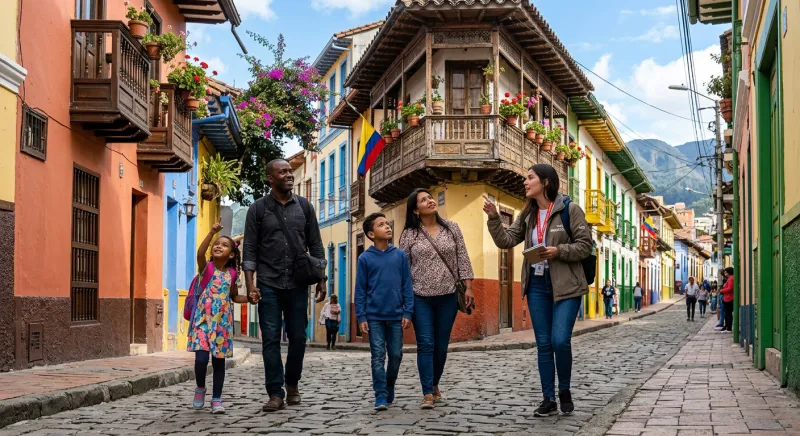
La Candelaria is the natural starting point.
Its streets bring together colonial houses, Republican-style buildings, churches, museums, cafes, plazas, and contemporary expressions of urban art.
Visit Bogotá defines La Candelaria as the city's historical heart, a neighborhood where stories linked to Muisca heritage, the colonial period, and various stages of the capital's history still coexist.
However, when traveling with children, there is one rule I usually apply: don't try to explain every single date and facade.
It is much more entertaining to turn the walk into an observation game.
Who can find a wooden balcony first?
Which house is the most colorful?
Where can you spot a hidden animal in a mural?
Which building looks the oldest?
This way, the architecture begins to tell its own story.
And adults end up noticing details they probably would have walked right past.
Chorro de Quevedo: Where History and Legend Meet
The tour can continue toward Chorro de Quevedo.
This small square is one of the most recognizable spots in the historic center and an excellent stop for introducing the first stories about Bogotá's origins.
I would avoid turning this moment into an overly academic explanation.
With a family, it works much better to talk about what the area might have been like when the city was just starting to grow, asking the kids to imagine those streets without cars, modern buildings, or smartphones.
Just a few steps away, one of the most interesting contrasts of the tour appears.
We transition from colonial imagery to contemporary Bogotá.
Callejón del Embudo: When Walls Begin to Speak
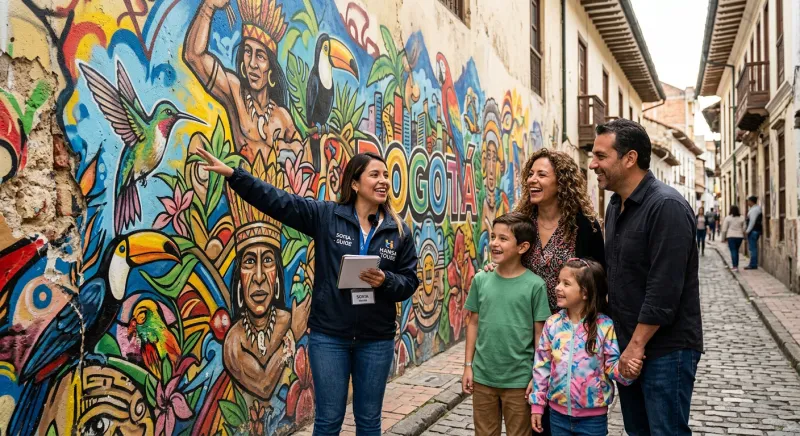
Entering Callejón del Embudo completely shifts the tone of the experience.
The building facades, murals, small local businesses, and narrow alleyways create one of the most photogenic settings in La Candelaria.
Visit Bogotá describes this alleyway as a place where neighborhood memory, history, and contemporary Bogotá blend together. Its walls have become canvases for diverse expressions of urban art.
Here, I recommend doing something a bit different with children:
- Don't explain the graffiti right away.
- Observe it first.
- What colors catch your eye?
- Which animals do you recognize?
- Are there any faces?
- What do you think the artist is trying to say?
The answers can be completely different between parents and children.
And that is precisely where the magic lies.
A Hands-On Graffiti Activity for Kids to Express Their Creativity
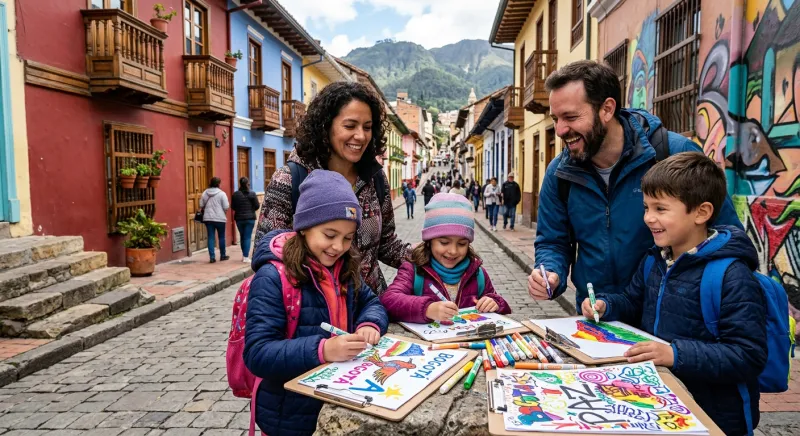
After taking in several murals, comes one of the most engaging moments: a fun creative activity inspired by Bogotá's urban art and graffiti scene.
The idea is not to paint on city walls.
Instead, each child receives paper, cardstock, or a portable surface to design their own artwork inspired by what they have just seen.
We can offer a simple prompt: “How I see Bogotá.”
One might draw Monserrate.
Another might draw a frog, a hummingbird, a mask, a bicycle, or an imaginary version of the surrounding mountains.
They can also experiment with lettering, artistic signatures, stencils, or geometric shapes.
More than creating a flawless masterpiece, the goal is for them to understand that urban art can communicate identity, nature, memory, and personal perspectives about a city.
The Hansa Tours graffiti tour approaches street art precisely from this cultural angle. Their routes pass through areas like La Candelaria and Callejón del Embudo, explaining the messages, styles, and artists behind the works. Furthermore, since these are private experiences, the pace can easily be adapted for families and different types of travelers.
The Best Moment of the Tour: A Break to Discover Colombian Fruits
After walking, listening to stories, and hunting for murals, children will need a break.
And this is where one of my personal favorite parts of the experience comes in.
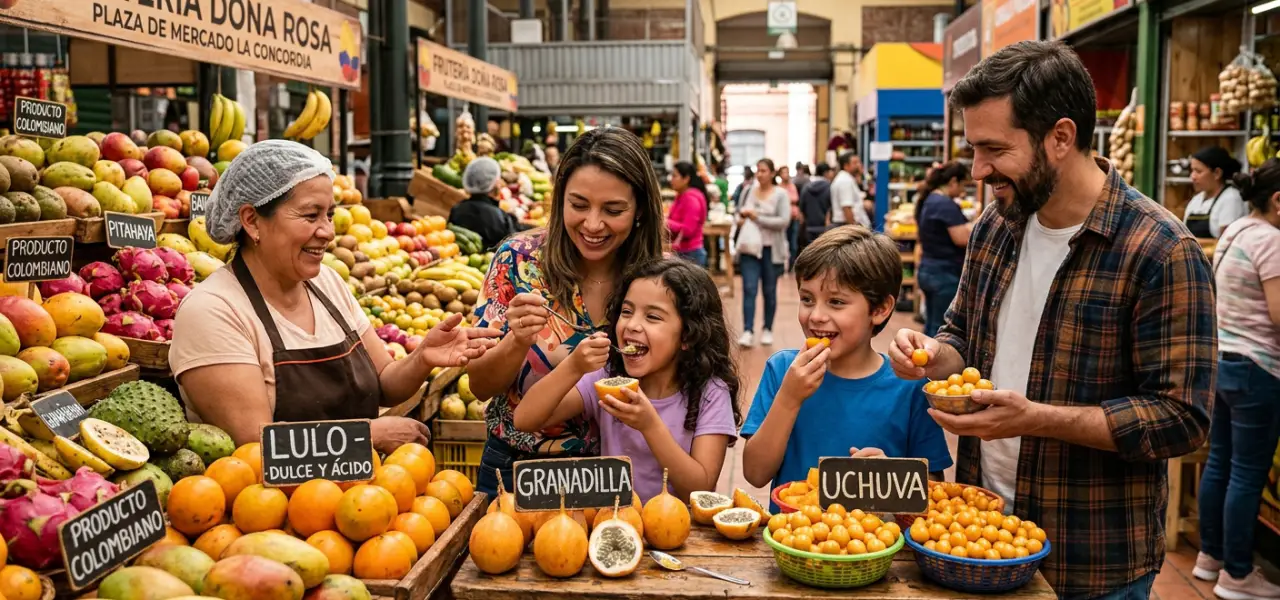
Instead of taking a conventional pause, we can turn rest time into a mini tasting of exotic Colombian fruits.
La Concordia District Market Place fits into the route perfectly.
Located right within La Candelaria, it gathers gastronomy, tradition, heritage, and fresh market produce. Founded in 1933, the market has been recognized for its historical, cultural, and architectural value, with traditional fruit stands and local market products among its highlights.
This break can easily be turned into a game.
Children inspect the fruits first without knowing their names.
Then, they try to guess how they will taste.
Sweet? Sour? Creamy? Juicy?
Depending on seasonal availability, we might encounter flavors like lulo, granadilla, golden passion fruit (uchuva), yellow dragon fruit (pitahaya), soursop (guanábana), or different varieties of mango.
The goal isn't for everyone to love every single fruit.
In fact, a surprised reaction after tasting something tart can end up being one of the best family travel memories of the entire trip.
La Concordia maintains a particularly strong tie to this tradition. The Bogotá Mayor's Office has highlighted its fruit stalls, fresh juices, and fruit blends as an essential part of the market's culinary experience.
Family tip: It is always best to share any allergies or dietary restrictions in advance so the tasting can be tailored appropriately to the children's ages.
Plaza de Bolívar: Understanding Colombia by Looking at Four Sides of a Square
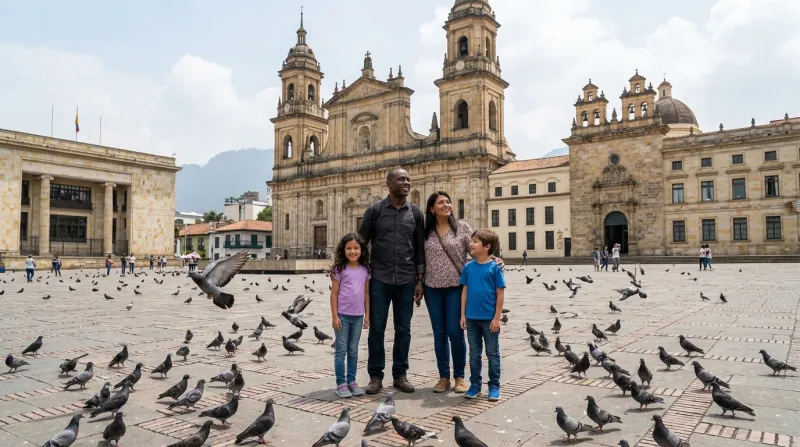
Recharged with new energy, we continue toward Plaza de Bolívar.
Here, I always suggest pausing.
Not just walking straight through.
Not just stopping for a quick photograph.
Truly pausing.
From a single vantage point, you can observe some of Colombia's most iconic political, religious, and administrative institutional buildings.
For adults, it is an opportunity to discuss architecture and history.
For children, we can turn it into another challenge.
Which building looks the most important?
Which one looks the oldest?
How many columns can you count?
Who can spot the statue of Simón Bolívar first?
The plaza works as a massive open-air classroom, just without desks.
Architecture Can Also Become a Game
One of the great advantages of exploring Bogotá on foot is watching how architectural styles shift within just a few blocks.
In La Candelaria, we find colonial facades, courtyards, traditional tiled roofs, and historic religious structures.
A few streets over, institutional buildings and far more contemporary designs emerge.
One of my favorite contrasts is found at the Gabriel García Márquez Cultural Center.
Designed by renowned architect Rogelio Salmona and inaugurated in 2008, the building is today one of the leading contemporary architectural and cultural landmarks of the historic center.
With kids, the building's circular spaces, ramps, brickwork, and sweeping perspectives can turn into another fun visual activity.
The question remains simple:
What differences do you notice between this space and the houses we saw at the start of our walk?
Without even realizing it, they begin learning about architecture.
Gold Museum: A Short Visit Can Be Worth More Than Two Hours of Display Cases
If the itinerary and day of the week permit, the Gold Museum (Museo del Oro) is an exceptional way to complete the experience.
However, when traveling with a family, I always prioritize quality over quantity.
There is no need to look at every single display case.
We can focus on animals, human figures, symbolic icons, and select objects capable of sparking curiosity and questions.
The official Bogotá tourism route combining Monserrate and La Candelaria features the Gold Museum and La Concordia Market Place as cultural heritage highlights of downtown. Keep in mind that the museum is closed on Mondays, so it is best to check operating hours before planning your route.
For a child, hunting for birds, jaguars, or tiny golden figures among the artifacts can be far more memorable than trying to memorize archaeological names.
Why Does This Experience Work So Well for Families?
Because the stimuli are constantly changing.
- In just a few hours, we go from walking to observing.
- From listening to drawing.
- From admiring architecture to sampling local fruits.
- From discussing the past to interpreting a modern mural.
Adults can dive deeper into history, urban planning, politics, and cultural heritage, while kids stay engaged through interactive games, flavors, and hands-on activities.
No two people need to experience Bogotá in the exact same way to enjoy it together.
That balance is one of the main advantages of private tours.
The La Candelaria tour by Hansa Tours can easily be tailored for young children and older adults alike, adjusting stops and pacing according to your needs. Depending on the chosen duration, it can include iconic locations such as Chorro de Quevedo, Callejón del Embudo, La Concordia Market Square, Plaza de Bolívar, the Botero Museum, and the Gold Museum.
A Cultural Route That Keeps Kids Engaged
Here is a recommended sequence to maintain a great pace throughout the day:
La Candelaria → Chorro de Quevedo → Callejón del Embudo → street art observation & creative activity → La Concordia Market Place & fruit tasting → Plaza de Bolívar → Gabriel García Márquez Cultural Center → Gold Museum, adjusting the final stops based on the group's age, weather, and energy levels.
In Bogotá, it is always better to leave something for next time than to end the day with exhausted children.
Tips Before Heading Out
Bogotá's weather can shift quickly, so I usually recommend comfortable clothing, a light jacket, and rain protection.
Proper footwear is particularly important in La Candelaria due to its cobblestone slopes and uneven surfaces.
When traveling with young kids or seniors, keep the pace flexible and avoid overwhelming the day with too many museum visits.
It is also wise to carry water and communicate any dietary restrictions or allergies in advance if you plan to do the fruit tasting.
And for the urban art section, don't forget a camera or a fully charged phone—it will likely be one of the most photographed parts of your journey.
Bogotá Doesn't Need to Be Explained: It Can Also Be Experienced
To me, that is the difference between simply visiting the historic center and truly discovering it.
Children don't need to memorize when every building was constructed.
They can look at their unique windows.
They don't have to study every art movement.
They can interpret a mural in their own way.
They don't need to study tropical botany.
They can taste the fruits for themselves.
And you don't need to spend hours explaining how Bogotá has evolved over time.
We can simply walk a few blocks and let them see the transformation with their own eyes.
History, architecture, flavors, and graffiti all come together as part of the same story: that of a city that continues to transform itself.
If you would like to explore Bogotá with a more flexible itinerary, Hansa Tours offers private experiences throughout La Candelaria, the historic downtown, and the urban art districts, allowing you to tailor the pace for families, couples, groups, and travelers of all ages.
Samuel Rojas
Hansa Tours
Unforgettable tours and experiences from our clients
See what our clients have to say about their incredible tours through Bogotá and various destinations across Colombia.
By the end of the week, I felt I'd made a new friend and was leaving a city I had fallen in love with. If and when we get to go back, I'll be asking Daniel to take us to more sites and share more of his favorite places with us. I can't adequately express how much his time and dedication to our trip meant to me. Absolutely wonderful tour guide.
Jessy CanadaExcellent tour all around. Arian was our guide and she was fun, entertaining and knowledgeable. Highly recommended.
Marc USAOur guide, Marcello, gave us a fantastic tour, his knowledge about the city of Bogota is admirable. Thanks to him we had a wonderful and memorable day.
Tony Brazil Robert (Hansa Tours)